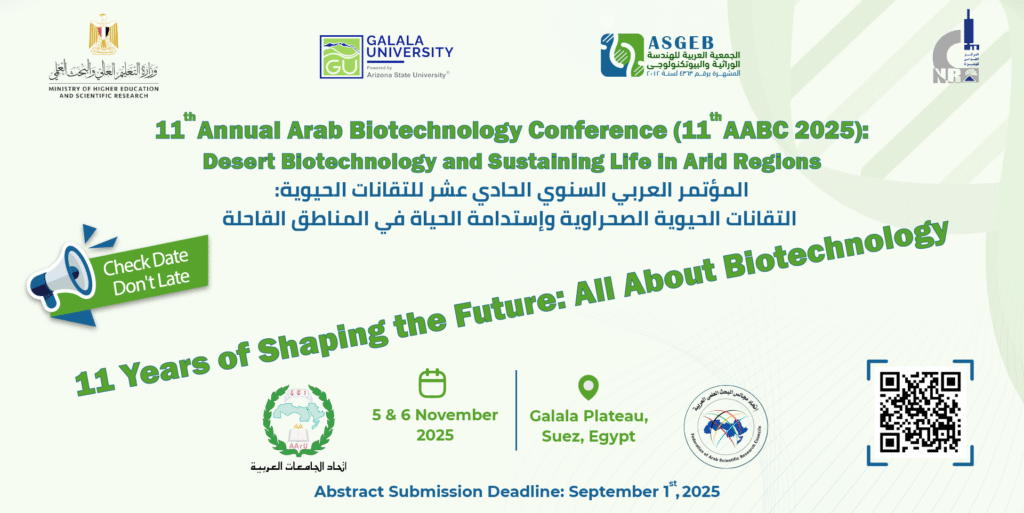
The Arab Society for Genetic Engineering and Biotechnology (ASGEB), in partnership with the National Research Centre (Egypt) and Galala University (Egypt), and in collaboration with the Arab Federation for Scientific Research Councils (FASRC) and the Association of Arab Universities (AAU), is proud to announce the 11th Annual Arab Biotechnology Conference.
This year’s theme, “Desert Biotechnology and Sustaining Life in Arid Regions,” aims to bring together researchers, scientists, and industry leaders to explore cutting-edge research, development, and innovative biotechnological solutions tailored to arid and semi-arid environments. The conference will also address the urgent challenges posed by climate change, food insecurity, and complex health challenges in these vulnerable regions.
To foster in-depth dialogue and showcase the latest advances in emerging biotechnologies, this year’s edition will feature 14 specialized workshops. These workshops will focus on the critical role of biotechnology in supporting national and regional efforts to address climate change, health crises, and food security in arid zones. Eminent scientists and experts from Egypt, Sudan, Jordan, Tunisia, Algeria, Morocco, Qatar, Saudi Arabia, Germany, USA, Malaysia, and India, as well as representatives from FAO, ICRISAT, and AARINENA, will chair, moderate, and deliver keynote lectures across the various workshops.
Contributors with accepted full papers will have the opportunity to publish their work in the Journal of Genetic Engineering and Biotechnology (Elsevier), subject to Elsevier’s peer review process.
We warmly invite your participation in this pivotal scientific event, dedicated to harnessing biotechnology for sustainable development in the world’s most climate-vulnerable regions.
Scientific Workshops:
- Better Agricultural Biotechnology for Better Food Security
- Plant Molecular Farming and Biotechnology of Medicinal Plants
- Recent Advances of Biotechnology in Health Care and Medicine
- Bioeconomy: Microbial, Environmental, and Industrial Biotechnologies
- Plant Molecular Breeding for Climate Resilience
- Desert Biotechnology and Arid Zone Innovations
- Nature Conservation: Gene Banks and Biodiversity Conservation
- Ancient DNA: Beyond Evolution and Unlocking Secrets
- Bioinformatics, Computational Biology, and AI
- Space Biotechnology
- Dairy Biotechnology
- Research Integrity and Assessing Researchers: Where we are and where we are heading?
- The role of IPR in incentivizing the development of New Plant Varieties
- Ethical Dimensions of Responsible Biotechnology in the Genomic and AI Eras